Showing posts with label monsters. Show all posts

Monday, May 25, 2026

Wraiths

Wraiths have a strong visual identity: hooded, faceless black figures. They are the Grim Reaper, the Ghost of Christmas Yet to Come, the Nazgul, even the Dementors (if you must). They look scary. Everyone knows the empty cowl means death. 

My own drawing

D&D doesn't know what to do with them. Are they corporeal? Do they paralyze or Energy Drain? Are they Nazgul or is that Spectres? It all depends on which edition you prefer. Delta has a great round-up

With their intimidating visages, wraiths should advance the thesis that I've explicated in previous posts (skeletons, zombies, ghouls, wights) that each undead type ought to be uniquely terrifying. 

My wraiths are of the semi-corporeal, black mist mode of wraithdom. They'll look solid enough, but your glaive-guisarme passes clean through. Unlike wights, wraiths don't have names or personalities. They are anti-life voids, avatars of nihilistic hatred. They just want to snuff all the candles. 

The Lord of the Rings: The Fellowship of the Ring (2001)

Death Spirals Revisited

These guys are brutal. They've got auto-hit life drain (don't worry, I won't make you deduct levels), dissolution at 0hp (no save, no res) and escalating damage that snowballs like a motherfucker.

This monster sets up tactical puzzle-fights and is a bit more mechanically complex than my previous undead. They can float over obstacles and flow between people, so fight positioning will be unusual.

Instead of the canonical level-drain, I've given the wraith an area-of-effect aura. Wraiths deal damage to all adjacent creatures, with no roll and the monster gains the hit points taken. This damage increases every round. The party needs to win fast or it will get out of hand. 

The goal here is for the players to fear them. For their arrival to be an "Oh, shit!" moment, without having to resort to level drain.

Muppets

Sunday, May 17, 2026

Wights

As the appellation Wight once referred to men, so too the creatures thus called were once mortal lords. Now they are bitter undead, who loathe and envy the living. Their visages are bleached and their personalities eroded by time, until nothing remains but fierce hostility and simmering resentment. 

They were lords and still believe they should be. 

My own post-it drawing, referencing this one by Vance Kelly

A Boss Suitable for Low-Level Parties

The wights in my game are an undead boss monster. I want something that can stand on its own thematically, not just a stronger zombie with "No. Appearing 2-16" and level-drain. 

A wight should have a name and a story.

In my version, I hope to bring back the dread and vindictiveness of the Tolkien original and evoke the draugr sagas they were based on (e.g. Grettir, Hrómundar and Hervör's saga, perhaps the barrow-dragon from Beowulf). Fun fact: the original use of the term "barrow-wight" was by William Morris in his Grettir's saga translation. I also thought of M.R. James' "A Warning to the Curious" and its BBC adaptation

Wights haunt the vicinity of their own tombs and must return to them during the day, unless they are deep underground. 

They'll gain the ability Shuttered Room suggested in their comments section, "undead being vulnerable to weapons that were made while they were still alive, so that rusty old broadsword is of use while that specially imported custom rapier is not." You can reduce them to zero hit points, but they'll dissolve and reform until they're finally dispatched with a suitably ancient implement.

They can track treasure stolen from them, with dire consequences for anyone paid with it. 

You'll think you've defeated one only to have it show up at your campfire a night or two later.

Cairn in Snow (1807) by Caspar David Friedrich 

Saturday, April 25, 2026

Waxen Shambler


My own drawing, referencing this.

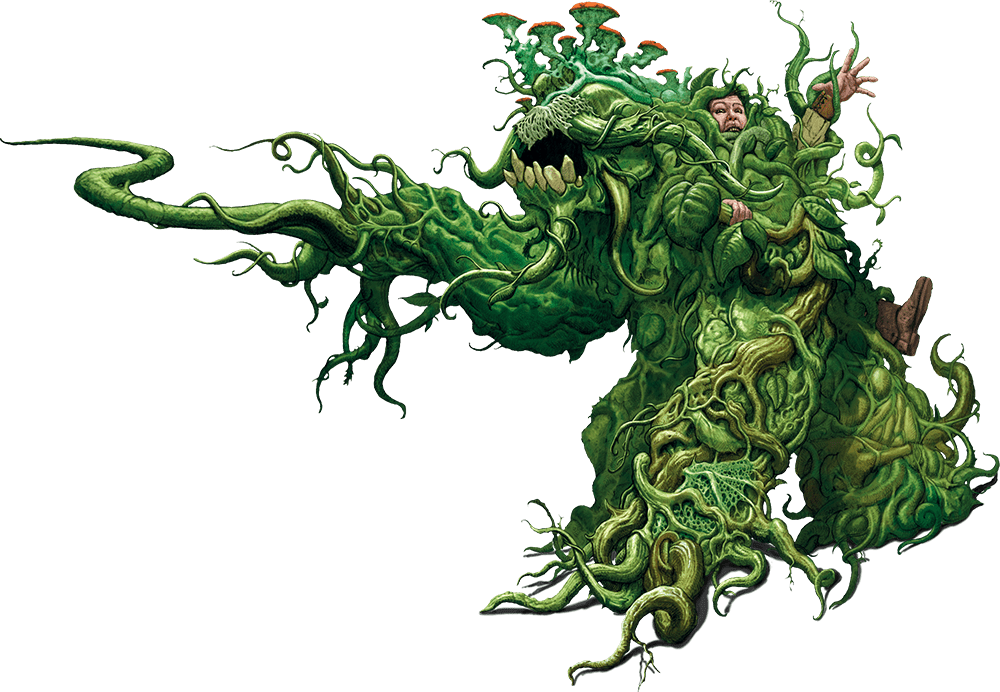
The Waxen Shambler (or Candle Golem) is an idea I came up with for a haunted chapel. It's essentially a Shambling Mound, comprising the waxy mass of hundreds of melted together liturgical candles rather than vegetation. 

Waxen Shambler

Armor Class: 10 - a slow moving blob isn't hard to hit

Damage Immunity / Resistances: Immune to normal missiles & bludgeoning attacks. Other weapons deal half damage.

Vulnerabilities: If it takes cold damage, it will move at half speed and only take one attack. If it is set on fire, it will take double the normal recurring damage but will act as if under the effects of a Haste spell until the fire burns out.

Hit Dice: 8d8 (36HP) + Regenerates 5hp / round

Attacks: 

  • 2x bludgeoning limbs, +2 to hit, d12 damage
  • Engulf - if both limbs hit, the target is swept into the mass of the shambler and will suffocate in 3 rounds unless freed.  
Move: Half human speed

Saves: 12+ 

Morale: Implaccable

Encounter Design

This thing is very hard to kill but pretty easy to flee. It won't chase beyond the church building.

My hope is that it pursues the party around the church area, maintaining pressure but they're smart enough not to stand against it toe-to-toe.

If they set it on fire... characters are likely to die. 

Loot

You'll undoubtedly find the oddments of previous victims lodged amid the mass.


Big inspiration for my design


Tuesday, March 25, 2025

Ghouls

Dekades8 on Devinatart

I feel a little silly including ghouls in my series of Undead revisions, since my model for this project, Arnold K's Monstrome, contains an extensive entry and my vision for this monster overlaps significantly with his. Nevertheless, ghouls are one of my all-time favorite classic D&D monsters and I want to crystalize my ideas in text (for my own use if for no other purpose).

Ghouls are an excellent utility monster that I find myself reaching for again and again while stocking my dungeons. With their multiple attacks and paralyzing touch, they are an absolute nightmare for players and remain a real challenge even for parties well above their level. 

Paralysis Death Spiral

I play in an OSE Arden Vul campaign and we recently encountered a mixed pack of ghouls and ghasts. Being a mid-level party and filled with hubris, we foolishly believed we could tank our way through. In one round, we were utterly thrashed, our best fighters paralyzed and several characters killed. We fled with half our number still living and a burning desire for vengeance. We came back, better prepared, and they kicked our asses again. This seems typical.

Ghoul's combat prowess borders on the unfair. A lot of people, both players and DMs don't like the brutality of Ghouls. Arnold removed their paralysis effect replacing it with a fear mechanic, saying "I don’t like how paralysis can disable half the party in a single turn, creating an instant death spiral (especially when surprise is involved), so I think this is a good change."  I disagree.

Ghoul's overwhelming abilities creates a fear and hatred of them that emotionally impacts the players in a way that few other monsters do. Having just experienced this, the frustration of rapidly losing characters that we'd spent months advancing, is fresh in my mind. When (on the third attempt) we finally beat them with an elaborate barbed-wire, tower-defense style ambush the sense of victory was incredible. 

A ridiculously overpowered, perhaps even un-fun, enemy from time to time adds something special to the game. It's exciting to have something to really fear.

Weaknesses

For all their lethality, ghouls are not that tough themselves. They typically don't have armor and with just two hit-dice, they fall pretty quickly once attacked. On average, they have single digit hit points. 

According to the 1e Monster Manual: "These creatures are subject to all attack forms except sleep and charm spells. They can be turned by clerics. The magic circle of protection from evil keeps these monsters completely at bay." 

In a different game I play in (in Stonehell) we encountered a ghoul infested area with a 7th level cleric and a paladin in the party. They melted like snow. 

Wednesday, January 22, 2025

Skeletons

Van Gogh

Of all the monsters in D&D, skeletons are the one most often depicted in art (of the non-game related sort). They are a constant theme. Drawn, painted and sculpted throughout history. A reminder of the inevitability of our own deaths and the monster that lives inside each of us, hidden behind a mask of meat and skin. 

William Blake

So of course I want to make them into a goofy cartoon monster. I want puppets and stop motion aesthetics. 

When you fight skeletons in my game, I want you to almost see the marionette strings. When you strike a mighty blow, they should burst apart with a clatter of scattering bones.

Disney

If you're going to take an easy, low-level undead fight for granted... these are the ones.

And yet... we still need them to be at least a little challenging to fight. They can't just be a very small stack of hit points.

Harryhausen

Strengths

Unlike the classic skeleton (BX/OSE and 5e), my skeletons are immune to slings and arrows (an outrageous fortune) and take half damage from piercing weapon. This makes them difficult to fight at range or if they are behind bars or a grate. This sets up lots of opportunities for adventurers to be harassed by weak monster that are difficult to get at. The challenge of the fight isn't rolling bigger numbers, it's figuring out how to get from here to there.

A complimentary feature is skeletons' ability to see in the dark and shoot further than torchlight extends. Arrows out of the darkness terrify players. This can be used to good effect to emphasize the importance of light.

Finally, skeletons have time on their side. They don't get hungry. They don't need a pee break or a nap. You can put them in a cage and hang them from the ceiling or brick them up behind an arrow slit. They can be a trap or an environmental hazard.

Weaknesses

In addition to being flimsy, skeletons are incredibly stupid. They are easily tricked. 

Sunday, January 19, 2025

Zombies

Maybe it's a fools errand, but I want to make the zombies in my game a little more interesting and threatening. I want my players to be genuinely scared of the undead.

I tried an iteration of this last year that fell bit flat so I've tweaked the recipe a bit.

Justin Moll

Sponge Monster

Zombies should shrug off weak hits and soak up a lot of damage before collapsing. On the flip side, in keeping with the tropes, one really big hit should take a zombie out. 

Instead of giving them a ton of HP, they'll get damage resistance (reduce the damage of each incoming hit by 4).  This will make them very resistant to arrows and small hand weapons. You'll want to hit these things with two-handed swords and polearms.

Deadly Infection

A zombie will first attempt to grab victims. Once grabbed, zombies will make bite attacks with advantage.

Any character bit by a zombie will contract grave rot, a deadly wasting disease that most low-level parties will not be able to cure. Getting bit by a zombie usually means death. 

Grave Rot: Every hour, lose 1/4 of your max HP. Hit points lost in this way can't be healed until the disease is cured. If you die while under the effect of Grave Rot, you'll return as a zombie (or occasionally some other undead). Grave Rot spreads from the point of infection. If it's on a limb, quick amputation can be a viable cure.

In B/X, 2HD crab spiders have save-or-die poison, so this doesn't feel too punitive.

Weaknesses

Zombies are slow and stupid. They always lose initiative and move at half normal human speed. If you can get out of their sight for one combat round, they'll forget you exist.

If a victim is brought down, zombies may stop fighting to consume it, ignoring anyone nearby unless directly attacked.

They are nearly always unarmored and make no attempt to avoid being hit. 

Monday, January 6, 2025

Tar Body Maggot


Darkest Dungeon

Maggots the size of a golden retriever. Slow moving, they are drawn by the smell of living flesh. They will attach themselves to any living creature and begin to feed. Any puncture of their thin skin releases a thick adhesive that can easily entrap attackers. 

Tar Body Maggot

Armor Class: 8 (unarmored). 

Hit Dice: 1d6 (HP4)

Attacks: First attack to attach (no damage), + 0 to hit, ignores armor. Once attached deals automatic damage each round until removed. First round deals 1 HP, second 2 HP etc. damage escalating as it chews its way further into the victim's more vital bits.

Move: 1/2 speed of unencumbered human. Can move on walls and ceilings.

Saves: 13+

Morale: Very stupid and will mindlessly pursue prey. Can be driven back temporarily by intense heat or cold.

Number Appearing: d10 x 3

Special: Hitting it with a bladed or piercing weapon releases super sticky goo. It will trap & tangle the weapon and potentially the attacker too (a la the folkloric Tar Baby). If killed, they melt into a big gluey puddle that will trap anyone stepping/contacting it. This smells intensely sweet and will attract other scavengers.

Friday, August 2, 2024

Mummy Hands

Little scuttling horrors. Disembodied hands skittering and leaping -- grasping, driving fingers into flesh with ab-human strength. 

They look like Thing but fill a niche with the face-hugger, the headcrab and the rot grub. An ambush, nuisance monster. Individually weak but very deadly if they slip past your defenses. 

Addams Family (1964)

Friday, April 12, 2024

How My Light is Spent

Drawing is mine, modeled on a panel in Dracula Motherf**ker
 
Lots of systems have existing light rules. Why make my own

I want my game to be streamlined so I don't always enforce rigorous torch timelines or sightlines. However for the right kind of classic dungeon there's a lot of interesting prioritization and strategy choices created by adhering to specific light rules. 

In this post, I've collected some of the things that make light & dark rules fun: monsters, spells, items and obstacles that create novel challenges and provide tools for creative problem solving.

Sean Cruz

This will be a fairly long post...

Sunday, February 19, 2023

Beastmen: An Introduction to the Brugor

Brugor are voracious, horny and irrationally violent. The worst qualities of man and beast mashed into drunk, shrieking, manic bullies. They are a scourge on the earth.

The Brugor exemplify the bestial excesses of humanity: unrestrained appetites, poor impulse control, and vacillation between slovenly sloth and irrational aggression. A parody of toxic-masculinity. 

This is a tried and true archetype in fantasy (particularly in games) and I can't claim any originality in the basic shape of these adversaries. Like many before me, I take inspiration from Glorantha's Broo and Warhammer's beastmen. Arnold K has a particularly good rendition (here and here).

Brian Froud

What are the Brugor?

The Brugor are an all-male race of horned, hairy, cleft-hoofed, animal-headed humanoids. They breed prodigiously with domestic livestock and can reproduce at an alarming rate. Given access to a heard of cattle, they'll produce a horde in a matter of months. Their young are standing within minutes of birth, and on the hunt shortly thereafter. 

The most common varieties vary with the breeding stock available in an area but the most often seen include bovine (i.e. minotaurs), caprine (goatmen), ovine (rams) and cervine (stags) types. Often an outbreak begins with wildlife, before moving into settled areas and afflicting farm animals. 

They are carnivores. Their preferred feed is humans but they'll eagerly devour any animal they can catch that they can't impregnate.  

While clever enough to use tools, they lack the industry to make them. Any weapons they use more advanced than a sharpened stick will be plundered from humans. 

Herds form around particularly strong individuals and raid together, becoming bolder as their groups grow larger. Fortunately, they are fractious and disorganized so warbands larger than a dozen or two are rare. Occasionally, they'll be forced into the service of a non-brugor leader but it is almost never worth the effort.

Left to their own devices, brugor lack the social organization to form settlements or coordinate anything but the most haphazard raids into human territory. However, their mean little minds are perfectly suited for infection by Baphomet. 

Wednesday, December 14, 2022

Monster/Hazard: Glue Snail

Darkest Dungeon

Snail the size of a large dog. Leaves behind a glistening slime trail that acts as a super strong contact glue. Stepping on the slime immediately adheres your boot to the floor.

Dungeon denizens often follow these slime trails to see what's been caught.


Glue Snail

Armor Class: 16 (as plate)

Hit Dice: 1 (HP4)

Attacks: None, see Special

Move: Glide 1/4 speed of unencumbered human. Can move on walls and ceilings.

Saves: 13+

Morale: Flees all conflict, slowly. If attacked directly, retreats into it's shell and glues itself to floor (+4 AC), shrieking loudly.

Number Appearing: 1

Treasure: Shell is worth 100GP if undamaged. If the glue-slime can be gathered and preserved, folks will want it.

Special: Slime trail is super glue. Anything adhered to it will be nearly impossible to remove without ruining the item. If flesh is glued directly, tearing it free will deal d2 damage. Distilled alcohol dissolves the glue.

Adventure Time 


Friday, November 4, 2022

Monster/Hazard: Powder Moth


Under the earth, beyond the reach of the sun's rays, where light is precious and maintaining torches and lanterns is a matter of life and death, the powder moth is a fearsome pestilence. 

Mothra

By the standards of terrestrial moths (of the sort well known to surface-dwellers), powder moths are enormous*. Fully grown, each is the size of a mid-sized dog with a wingspan wider than a man's outstretched arms. 

Powder moths are drawn ineluctably to light and if they come into direct contact with open flame they explode violently. 

Powder Moth

Armor Class: 8 (unarmored)

Hit Dice: 1-1 (HP2)

Attacks: None, see Special

Move: Fly x2 speed of unencumbered human

Saves: 15+

Morale: Drawn to light, avoids all other contact

Number Appearing: 1d6

Treasure: Corpse is worth 100GP to an alchemist.

Special: Drawn to any light source and explodes on contact with open flame dealing d6 blast damage to all creatures in immediate proximity. Enclosed flames (e.g. glass lantern) won't detonate moths but moths will collide with the light source repeatedly.

___

Powder moths infest subterranean areas and feed on Yellow Mold (a la AD&D Monster Manual). 

Although they are reviled by torchbearers and linkboys, delvers often hesitate to exterminate populations of moths because their removal typically results in rapid fungal expansion. 

The wings of dead moths can be carefully ground to produce a black powder used in the production of grenades and as propellant for cannons. It is rumored that the Imperial legions farm powder moths in depleted mines to supply their artillery. 

bowelfly on tumblr

*Powder moths (and other large chthonic moths) are dwarfed by the truly titanic moths that live in the outer void, with bodies large enough to host cities.

Discussion

I've been trying to come up with some unique low-level monsters for my wandering monster tables. I want adversaries that are hazard/challenges rather than just HP piles to chop through. 

The presence of powder moths adds a layer of consideration (the ever-popular torch & molotov load-out becomes a risky move) that should make an area feel distinct.

The first time these are encountered they'll be a real threat. Explosion followed by darkness. 

Once the party has figured out a strategy to defeat them, they become a resource rather than a danger. I can imagine all sorts of PC schemes to hunt moths for their explosive potential.  

Saturday, August 7, 2021

Demoniad (Part 3): Practical Demonology


After two posts blathering on about the creeping chaos of demoniac meta-physics and planar cosmology, it's time to get down to practicalities. 

Design Goals

In a recent episode of the Monster Man podcast, James talked about the "Creatures of the Warp" and the importance of making chaotic outsiders from beyond normal space, feel truly alien. In game terms, they should break the rules, and do things that other monsters can't do. They can't be just another stack of hit points.

Another priority for me in exploring demons in my setting is showing their mutability. Not only are demons existentially corrupting to everything they touch, they themselves are also changed. Consequently, once you start finding demons, you'll see lots of mixtures of demons and other things. Demon-dragons, demon-possessed sorcerers, demon-animals, demon-oozes... and on and on. 

Since I'm prioritizing, reality-bending and inconsistency, I can't just pull a standard stat blocks for Tanar'ri.

Sunday, May 30, 2021

Skeletongue


In the same way that all humans grow to maturity with an instinctive knowledge of mankind's common tongue, and every beast knows, without being taught, the language of its kind, so it is with skeletons. They all share the same rattling, teeth-clacking "speech."  

Skeletongue is an easy language for others to learn. The difficulties of pronunciation that come with other languages are irrelevant and the natural vocabulary of the language is very small. The precise rhythms can be tricky to imitate at first, but once the cadence is found, the rest of it usually proves straightforward. At the more demanding schools of necromancy, students are expected to master the language in less than a month.

The written langue is similarly rudimentary. The traditional script is just a line of dots and dashes.

Of course, such a simple language comes with a number of disadvantages. It takes a long time to say anything complex. Nuance and tone are next to impossible to convey (This is unfortunate, given the lack of facial expression for most of its speakers.). Finally, the language has very limited variation in volume. You cannot shout in Skeletongue. 

Disney

Given these limitations, skeletons use gesture and pantomime to indicate emotion and communicate in loud environments. As a result, emphatic conversations often looks like a comical, gesticulating dance to outsiders.

Disney

Although skeletons themselves never do it, others who know the language can use it to communicate by tapping stones together, or even flashing a light. Relays of signal lamps, communicating via skeletongue, have become popular in some regions as a method of long range communication.

Saturday, May 15, 2021

Demoniad (Part 2)

The Abyss

At their purest, demons exist in non-space, in non-time. They have no memories and no conception of a future. They have no bodies and no ability to perceive.  For them, there is only the present and, insatiable desire. In the void, their hunger has no object, interaction is impossible. This existence is horrible.

Bosch

The realities that we know are islands in this nothingness, mere specks.

Sunday, May 2, 2021

Demoniad (Part 1)


Demons are perhaps the foremost antagonist in my D&D setting. I conceptualize them as a blend of traditional chaotic-evil D&D demons, Warhammer's chaos daemons and Lovecraft's malevolent Outer Gods.

Things fall apart; the centre cannot hold;

Mere anarchy is loosed upon the world,

The blood-dimmed tide is loosed, and everywhere   

The ceremony of innocence is drowned;

- The Second Coming by W.B. Yeats

The expanse between worlds is not empty. Compressed into the spaces around coherent realities, demons fill the non-places in infinite numbers. They thrash and batter at the boundaries of existence, pressing in greedily, eager to corporealize and burn the world.

Demons are the incarnate manifestations of chaos. They hate structure and constraint above all else. The only thing saving the multiverse from overwhelming annihilation is their inability to organize. 

Wednesday, April 14, 2021

Face in the Furnace

DM notebook sketch 

This is an antagonist that I sort of made up, mostly stole. It's a stationary boss-preview monster. 

Wizard Phone

When a wizard is tired or her message is mundane, she'll send a courier or put it on the clacks, just like us regular folks, but when a message is really important and secrecy is imperative she'll probably send it via fire.

Really, it's not that hard if you have an appropriately prepared brazier on each end and know the right semantic coordinates. A few minutes of concentration and poof, your face appears bobbing and flickering in your correspondent's flame, and their's in yours. It's a skill nearly every professional wizard knows.

Cunning wizards of particularly deft power don't even need a special preparation on the other end. They can speak or spy from any mundane fire. This has created a bustling trade in herbs and hearth additives to prevent this sort of intrusion.

Praman Nand on Hell 71

This is a concept that's been omnipresent in folklore and fantasy fiction but the above panel from Kill 6 Billion Demons has really stuck in my head. 

Boss Phone

When an archmage, demonlord, or other major, campaign-arc defining bad guy needs to communicate with his lieutenants, cultists or assorted party-level appropriate mooks, he can give them a call via a furnace level inferno. It'll project him super huge and scary and with a thunderous booming voice. 

It makes him feel important. Better yet, it gives scrappy adventures a chance to interrupt a bad-guy teleconference and meet the Big Bad while they're still low level without getting squashed.

Saturday, March 13, 2021

Hypodermic Spider

This week I ran another Gus L mini adventure, the Star Spire which features glass spiders as the primary antagonists. 

Gus describes transparent spiders with venom visibly sloshing around inside their bodies. A very cool image! It started me thinking and I came up with a slightly different take that I really like:

I should have drawn eight legs

The Hypodermic Spider 

# Appearing: 3-12

HP: 1

Size: Like a biggish dog.

Attacks: 1x per round. 1d4 damage + special.

Special: On a hit, roll a d6.

1: Head - 2x damage, face paralyzed, speech is impossible.

2: Body - 2x damage

3 - 6: Limb paralyzed and unusable.

Each player draws a little figure and marks paralysis

Breaking the central toxin basin: Save vs paralysis.

Wednesday, July 15, 2020

Thurstle Island: Oozes of the Undercity


Jared Murphy (King328)
In my Thurstle Island campaign, oozes in their many varieties are the corrupted remnants of the Ancients' servitors. Their minds were poisoned by the malign influence of the Twisted Wyrm, buried nearby. This is not an original idea. It is drawn directly from Lovecraft: 
They had always been controlled through the hypnotic suggestion of the Old Ones, and had modelled their tough plasticity into various useful temporary limbs and organs; but now their self-modelling powers were sometimes exercised independently, and in various imitative forms implanted by past suggestion. They had, it seems, developed a semi-stable brain whose separate and occasionally stubborn volition echoed the will of the Old Ones without always obeying it.
The oozes, slimes and jellies overthrew their creators but lacked the sophistication to form a society of their own. Effectively immortal, they have roamed the decaying city for centuries, some are maddened and consumed with hatred, others are merely bewildered and frustrated.

I don't want oozes to be just another sludgy slurry of hit points. Consequently, ooze-type creatures take no damage from weapon attacks. Deciphering their other vulnerabilities is what makes them fun. Each type of ooze is it's own mini-game.

Oozes do share a few things in common: 
  • They hate the cold. It slows their movements and their minds. Even minor chilling magics will dramatically reduce their mobility and power. Freezing an ooze solid then shattering it, is one of the few methods that works on nearly every type.
  • They are often disrupted by admixture. Dirt, salt, water. It depends on the variety of ooze what bothers them most.
  • They can climb vertical pipes and shafts if the concentration of their bulk is large enough to fill the space. I.e. a 10' Jelly Cube can ascend an 8' wide shaft but not a 15' diameter pipe.
  • They can squeeze through cracks and small spaces though the process is usually slow. 
  • They cannot cross a grate without dropping through.
Fortunately for the players, rods of ooze control are not too uncommon in the Ancient City.

Wednesday, March 23, 2016

Feisty Flora

The woods west of Stutterheim are well known for their treacherous, cruel inhabitants and the perilous predators that stalk in their shadows, but these are far from the only threats. Even the plants of the cursed forests are eager to shed human blood.

Stinging Creepers - Pale ropey tendrils hang down from high branches. They slowly bend towards nearby creatures, and gently feel along their surface until they touch skin. If they touch the skin of an appendage it receives a painful sting and is paralyzed for 10-60 minutes. Stings to the head prevent speech and cause the eyelids to droop, imposing disadvantage on attacks. Severing the tendrils, releases a strong smelling chemical that attracts predators. 

The disconnected vines maintain their potency for many hours and are occasionally used by herbal healers as a surgical anesthetic (the sting being much preferable to the agony of an amputation). However, the smell increases in intensity as the creepers decay and so most savvy foresters are loathe to attract danger by keeping them around.
Charnel Tree - A black, leafless tree thrusts from the ground like a hand grasping at the sky. Upon approach, corpses can be seen impaled on thick branches with sharp, jagged ends. These branches  protrude upward from the trunk like needle-fingers.

The tree is paralyzed while any creature looks at it but if anyone turns  their back while within its reach, a branch will strike out and skewer them. The branch will return to its original position, with its victim hoisted aloft in the blink of an eye. Over the next few days, rootlings  will burrow into the flesh and digest it.

A close examination of the trunk will reveal an elaborate carved character. Defacing this character will banish the tree's animating spirit. Replicating the character in the trunk of another tree will cause it to be similarly possessed within a few weeks. 

The wood of a charnel tree will not burn, even if its spirit is exorcised.

Winkle Moss - In the freezing wastes, spongy pads of lilac colored moss occasionally grow in sheltered spots in the lee of rock outcroppings or amongst the roots of gargantuan ancient trees. The moss gives off a  gentle warmth and may appear to be an ideal resting place, out of the frigid wind.

Anyone reclining on the moss will gradually become drowsy, and drift into a soothing sleep, where they will dream peacefully (these dreams while vague and difficult to remember, foretell the future). They will not wake on their own and anyone trying to rouse them will have tremendous difficulty. After a few hours of sleep the moss will slowly grow up, engulfing and eventually smothering the sleeper. Any attempt to tear or disturb the moss will cause intense, terrifying and prophetic  dreams in those under its influence.

A sedative tea can be brewed from Winkle Moss. It tastes like chamomile and dust.


Vorpal Ferns - Long stiff fronds, colored a distinctive inky-green and displaying a glossy sheen are the identifying feature of Vorpal Ferns. Voluminous banks of these ferns grow symbiotically around the roots of many large deciduous trees in the murky black forests of the west.

The leaves of these ferns are entirely rigid and their edges, wickedly sharp. They slice through flesh like razor wire and easily pierce thick hides and tough leather. Falling into a clump is like being thrown down a  spike pit. If a naïve forest visitor, attempts to grasp a stalk, fingers may be lost.

If severed from its roots, a fern quickly degrades and becomes soft and harmless. If harvested carefully, they can be gathered into a comfortable sleeping mat.

Recently, protective hedges of vorpal ferns have become popular as defensive landscaping around the manses of the Stutterheim nobility.

Incense Daisies - The beautiful pale-pink petals of the incense daisy are one of the few contrasting notes of color in the dim, drab undergrowth of the western woods. These flowers omit a delicate, sweet scent and are collected by forest dwellers and fragrantly burned to pacify forest spirits.

The flowers are also extremely attractive as a food to most mammalian beasts. Unfortunately, the plants contain a sap which causes animals who consume them to become uncontrollably violent. Travelers must be careful to prevent their pack animals and hounds from foraging but may find it difficult to counter the flowers' allure.

Within an hour of eating incense daisies, an animal will have a psychotic episode, attacking any nearby creature, or if no creature is close, destroying the surrounding plants. These episodes are mercifully short, usually lasting just one to six minutes.