Sunday, July 4, 2021

More Favorites

It's been much too long since I've done a shout-out post. The last time I did, people still thought that the "novel corona virus" was basically just a bad flu.

Map Crow is fantastic. I know that Ben Milton just gave him a highlight in the latest issue of the Glatisant, but for real... check this out. Most of his vids have < 500 views and that seems totally wrong. 


This week, The Lizard Man Diaries has released a Part 2 to the incredibly useful Generic Room Stocker (now available in PDF). I'm looking forward to filling up a few levels of my City of the Ancients with "generic" content like: 

A room that is "Ethereal and vaporous - twisting, flowing and floating." Ornamented with "decorative weapons" that are "far to flat" and "vaguely incorporeal". An "inhabitant, puzzling over the way in which a device is used", reacts "mockingly and "derisively" but is "open to discussion." The devise "informs" but "requires a sacrifice to operate.


Labytinths of Illrith Varn from Swamp of Monsters! In May 2020 Nate L. described "how i did my megadungeon." Earlier this week, he posted a campaign summary and map overview. I really enjoyed reading the original post laying out how the dungeon was created, followed by the look-back on how it worked. 

72 Encounters from the City of Spires from Against the Wicked City. Joseph Manola has packed years of his campaign into a giant table of awesome mini-adventures, plot hooks and city encounters. Back in September, he did a series of posts (1, 2, 3) on how he runs the campaign. Reminds me a bit of the map he posted in 2019 for his previous Team Tsathogga campaign (which I found very inspiring) but at a zoomed in level.
In Classic Vs. The Past,  All Dead Generations considers how modern games differ from the games of the 70s and 80s. Gus L. points out four major departures in how the games are played and gives some suggestions on how to address these in campaigns.

  1. Two to three hour sessions
  2. Shorter campaigns
  3. Smaller groups
  4. Online play
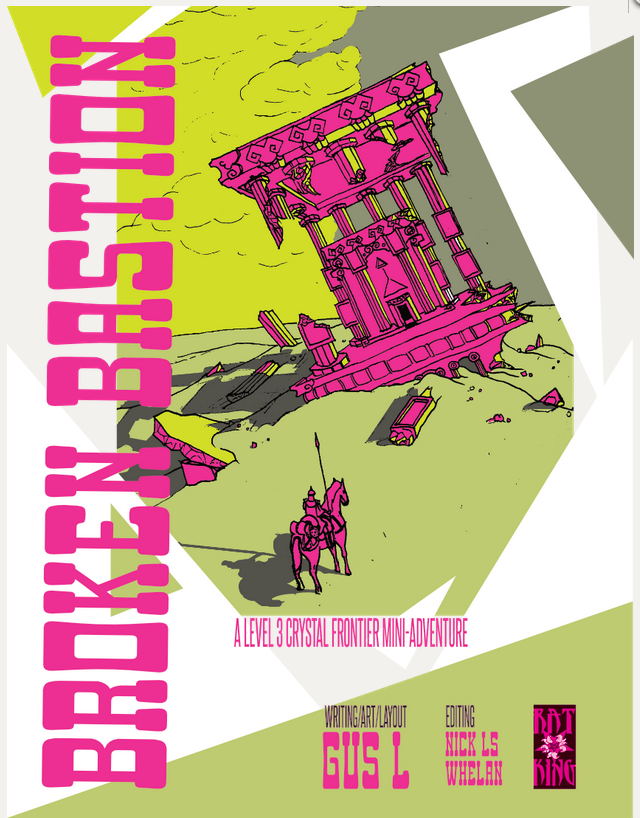
Gus has also released several adventures this year, which I highly recommend. The Bruja, The Beast and The Barrow which I ran and reviewed back in March and Broken Bastion which I've purchased but haven't run yet.

A Thorough Look at Urban Gameplay in D&D from A Knight at the Opera. Exactly what it says on the tin. A truly excellent compilation. 

Chris Tamm of Elfmaids and Octopi continues to be awe-inspiringly prolific. It's hard to pick what to link but I enjoyed this post about Dungeon Ants and this one about Omnisaur + Dungeon Design in which he describes "I might try some alternate configurations when done and have them as bits a GM could cut out and reassemble or ad to some other map. A strange new kink in my process." I'm thinking about some cut-up dungeons too so it was nice to hear someone else on that track. 

PrinceofNothing is Introducing a No-Artpunk Contest. Despite the fact that I like most of what I've seen described as "artpunk" and have run 20+ sessions of Mork Borg, I think making an old-fashioned, "back to the Moathouse" sort of dungeon could be fun.

___

I'm sure I'm missing a bunch of deserving people. Hopefully, I'll catch them the next time I do this (hopefully sooner than 16 months this time...)

Saturday, July 3, 2021

Thurstle Island: Ruined Fort of the Crusaders


In our most recent session, my players explored the first level of the Barrow of the Twisted Wyrm. They retrieved, the major artifacts and saw the clear evidence that the barrow had been previously looted by Gothic knights. They have deduced (correctly) that the corpses they found (as armored zombies) were likely from the abandoned fortress on the hill above the town. They're planning to explore the fort in our next game.

Getting back to the fort will be challenging. The only way the players know to reach the fort takes them through both the  Old Forest and the upper portions of the Smuggler Caves.The druids in the forest are furious that someone has desecrated the barrow, and the Smugglers (the "Willing Few") are beginning to rebuild their operations after the player characters wrecked their hideout.

Sunday, May 30, 2021

Skeletongue


In the same way that all humans grow to maturity with an instinctive knowledge of mankind's common tongue, and every beast knows, without being taught, the language of its kind, so it is with skeletons. They all share the same rattling, teeth-clacking "speech."  

Skeletongue is an easy language for others to learn. The difficulties of pronunciation that come with other languages are irrelevant and the natural vocabulary of the language is very small. The precise rhythms can be tricky to imitate at first, but once the cadence is found, the rest of it usually proves straightforward. At the more demanding schools of necromancy, students are expected to master the language in less than a month.

The written langue is similarly rudimentary. The traditional script is just a line of dots and dashes.

Of course, such a simple language comes with a number of disadvantages. It takes a long time to say anything complex. Nuance and tone are next to impossible to convey (This is unfortunate, given the lack of facial expression for most of its speakers.). Finally, the language has very limited variation in volume. You cannot shout in Skeletongue. 

Disney

Given these limitations, skeletons use gesture and pantomime to indicate emotion and communicate in loud environments. As a result, emphatic conversations often looks like a comical, gesticulating dance to outsiders.

Disney

Although skeletons themselves never do it, others who know the language can use it to communicate by tapping stones together, or even flashing a light. Relays of signal lamps, communicating via skeletongue, have become popular in some regions as a method of long range communication.

Friday, May 28, 2021

Bunkers & Dragons: Machine Guns for D&D

Crappy notebook map

In watching a series of WWII history vids on YouTube, I had the idea that mid-20th century infantry tactics could make for a novel series of D&D adventures. 

Squad tactics, pivoting off machine-guns, fields of fire and flanking maneuvers feel very chess like. Figuring out how to assault a position with interlocking fields of fire without getting splattered seems like a worthy challenge. 

Saturday, May 15, 2021

Demoniad (Part 2)

The Abyss

At their purest, demons exist in non-space, in non-time. They have no memories and no conception of a future. They have no bodies and no ability to perceive.  For them, there is only the present and, insatiable desire. In the void, their hunger has no object, interaction is impossible. This existence is horrible.

Bosch

The realities that we know are islands in this nothingness, mere specks.

Friday, May 7, 2021

Imaginary Metaphysics

Berkeley

Preamble: I doubt that my players care about the metaphysics of my D&D world, but thinking about how it all fits together, makes imagining a world more fun for me. In order to keep it straight in my own head and perhaps provide an overview if anyone happens to be interested, I've started formulating my ideas on the page.

An Introduction

You think therefore you exist.

Your thoughts exist because you think them.

In the world of your imagination, you have full control. Everything is fully malleable to your whims and changes as you will it. When you forget or get distracted, it all disappears.

You are not the only consciousness, not the only will. There are others. We'll call them "souls."

How do you interact with other souls? There must be some shared space, an environment of interaction where your ideas and theirs coexist and where concepts are held in common. We call this "reality"

Reality is very different than your imaginary world. Its objects are not dependent on you for existence. It operates on rules external to you. You cannot rearrange everything merely by wishing it so. Instead you are limited by your position, limited by the force of your will, limited by the wills and perceptions of others. Fortunately, you have a vehicle for interaction, this is your "body."

A body is an intellectual tool, used for navigating shared reality. It compiles the compounding structures, rules and limitations that you encounter and organizes your perceptions into something comprehensible. This processed experience appears to you as the physical world. Matter and energy represent shared ideas. Physical space corresponds to conceptual positioning.

Your perceptive facilities manifest as bodily organs (eyes, ears etc.) and you affect the shared reality through the actions of your body. When your hand moves an object, it moves for everyone. You can communicate with other souls via manipulation of physical reality (like the air vibrations produced with your voice).

"Ineluctable modality of the visible: at least that if no more, thought through my eyes"

- Ulysses, James Joyce  

Participation in reality is non-elective. You are anchored to your body and through it, perceptions pour into your consciousness. All external information comes in through your body and is processed through the frame of physicality. Other souls perceive you and you are accessible to their wills. In a significant way, you are stuck in the material world.

This is your situation.

___

This could describe "real" reality. I'll get into fantasy below. 

Sunday, May 2, 2021

Demoniad (Part 1)


Demons are perhaps the foremost antagonist in my D&D setting. I conceptualize them as a blend of traditional chaotic-evil D&D demons, Warhammer's chaos daemons and Lovecraft's malevolent Outer Gods.

Things fall apart; the centre cannot hold;

Mere anarchy is loosed upon the world,

The blood-dimmed tide is loosed, and everywhere   

The ceremony of innocence is drowned;

- The Second Coming by W.B. Yeats

The expanse between worlds is not empty. Compressed into the spaces around coherent realities, demons fill the non-places in infinite numbers. They thrash and batter at the boundaries of existence, pressing in greedily, eager to corporealize and burn the world.

Demons are the incarnate manifestations of chaos. They hate structure and constraint above all else. The only thing saving the multiverse from overwhelming annihilation is their inability to organize.