Thursday, June 11, 2026

Mummies

Mummification is an act of optimism. An irreversible bet that the future will be better than the present. It's a big investment to have a secure tomb built, a body prepared and (often reluctant) favored retainers rounded up for interment. The commitment of capital is total, an undiversified stake in the most illiquid of assets, a spice-packed, spell-swaddled, sealed-for-freshness corpse.

Mummification is the cryonics of my setting's bronze age. When things went wrong, when the sky fell, when the heavens warred, in the days of Ragnarok, of Apocalypse, the Flood and the Sea People, the great high priests and god-kings retreated from the world to sleep through disaster and awake to a new day, when they could emerge and resume their rightful dominance.

Karloff in the Mummy (1932)

After our recent discussion of the wight and wraith, monsters with comparatively weak presence in the popular imagination, we're once again examining a monster with a lot of cultural resonance. All the usual writers had a go at mummy stories (Poe, Conan Doyle, Stoker, later Lovecraft & Rice) and there's a stack of memorable movies: Karloff for Universal, Lee's Hammer mummy and then the 1999 action romp reboot. Each with a constellation of sequels and spinoffs. 

When mummies appeared in the original D&D Monsters & Treasure booklet, they were culturally ubiquitous and that popularity has continued to the present. 

All that to say, your players might not know what a wight is but they definitely have a mental image for mummies. Does the D&D mummy actually feel like the mummy pre-existing in players' imaginations? Does it have anything interesting to do?

Lee in The Mummy (1959)

Mummy Dearest

Across D&D editions, the mechanical structure of the mummy is fairly consistent: Fear-based paralysis, melee hits convey rotting disease, resistance to basic attacks. Usually vulnerable to fire. It's a tough, but eminently physical threat (distinguishing it from the wraith & spectre) and often has a religious/cleric flavor (distinguishing it from the Lich). Honestly... very solid. 

Of the Basic undead, the mummy is one of my favorites.

The initial save vs. paralysis can swing a fight. I've run into mummies a couple of times recently as a player in an OSE Arden Vul campaign. In the first, we mostly made our saves, volleyed spells and crushed the mummies handily. In another tomb-raid, we discovered mummies but most of the party (including our cleric) failed the fear save and it turned into a desperate scramble for escape in which we lost several characters. 

We managed to avoid the Rot but that's another iconic, thematically resonant danger. It's an effect that lingers and often even a successful fight results in a side-quest to find a cure. 

Even as a mid-level party, discovering mummies is a tense, scary moment. 

Vulnerability to fire is also perfect. On the level of practical instinct, a dehydrated, cloth or paper enveloped corpse seems like an ancient Duraflame. On the fictional memory level, Karloff's Imhotep is destroyed when his animating scroll is burned by holy fire. 

Trampier for the AD&D Monster Manual. This rocks

We'll keep all this good stuff in and I'll add a sprinkle of my own spices as we wind up the bandages and tie it off with a bow. 

Monday, June 8, 2026

Speedy Starting Equipment

I recently started a new Ultra  Bastard campaign with some players who are completely new to role playing games. Wanting to get into the action as quickly as possible, I opted to forego purchasing equipment at character creation and instead made this little chart.

It's a handy thing to have printed out & pasted into my DM notebook and I'm sure it'll get a lot of use in the future. 

Posting it here, in case it comes in handy for any of y'all. 


Thursday, May 28, 2026

Pick Your Poison

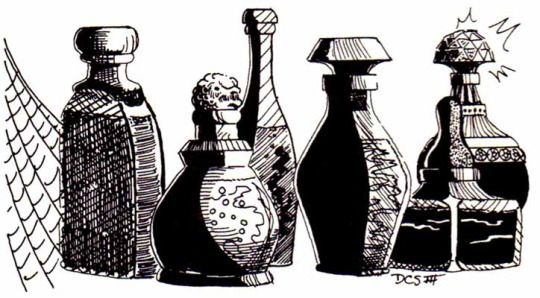
Sometimes it's handy to have a list of poisons. 

When stocking a dungeon or a search-the-body table, it's nice to add something specific to the key rather than just "poison" and, if you're running someone else's key, what does "poison" actually do?

There's a page in my DM notebook for just this eventuality: 

Ignore the central diagram. It's an artifact of a recycled page.

The poisons I've pre-loaded on the page are mostly gestures toward real world toxins. They might not be medically accurate, but the profiles are recognizable. These seemed like a good starting basis for improvisation and cannibalized concoctions. Lots of space on the page to add new entries as they come up in play. Reproduced below, so that you don't have to suffer through my hand-writing.

If you have poisons that you like to use in your games, please put them in a comment. 

Nightmare Before Christmas

Monday, May 25, 2026

Wraiths

Wraiths have a strong visual identity: hooded, faceless black figures. They are the Grim Reaper, the Ghost of Christmas Yet to Come, the Nazgul, even the Dementors (if you must). They look scary. Everyone knows the empty cowl means death. 

My own drawing

D&D doesn't know what to do with them. Are they corporeal? Do they paralyze or Energy Drain? Are they Nazgul or is that Spectres? It all depends on which edition you prefer. Delta has a great round-up

With their intimidating visages, wraiths should advance the thesis that I've explicated in previous posts (skeletons, zombies, ghouls, wights) that each undead type ought to be uniquely terrifying. 

My wraiths are of the semi-corporeal, black mist mode of wraithdom. They'll look solid enough, but your glaive-guisarme passes clean through. Unlike wights, wraiths don't have names or personalities. They are anti-life voids, avatars of nihilistic hatred. They just want to snuff all the candles. 

The Lord of the Rings: The Fellowship of the Ring (2001)

Death Spirals Revisited

These guys are brutal. They've got auto-hit life drain (don't worry, I won't make you deduct levels), dissolution at 0hp (no save, no res) and escalating damage that snowballs like a motherfucker.

This monster sets up tactical puzzle-fights and is a bit more mechanically complex than my previous undead. They can float over obstacles and flow between people, so fight positioning will be unusual.

Instead of the canonical level-drain, I've given the wraith an area-of-effect aura. Wraiths deal damage to all adjacent creatures, with no roll and the monster gains the hit points taken. This damage increases every round. The party needs to win fast or it will get out of hand. 

The goal here is for the players to fear them. For their arrival to be an "Oh, shit!" moment, without having to resort to level drain.

Muppets

Sunday, May 17, 2026

Wights

As the appellation Wight once referred to men, so too the creatures thus called were once mortal lords. Now they are bitter undead, who loathe and envy the living. Their visages are bleached and their personalities eroded by time, until nothing remains but fierce hostility and simmering resentment. 

They were lords and still believe they should be. 

My own post-it drawing, referencing this one by Vance Kelly

A Boss Suitable for Low-Level Parties

The wights in my game are an undead boss monster. I want something that can stand on its own thematically, not just a stronger zombie with "No. Appearing 2-16" and level-drain. 

A wight should have a name and a story.

In my version, I hope to bring back the dread and vindictiveness of the Tolkien original and evoke the draugr sagas they were based on (e.g. Grettir, Hrómundar and Hervör's saga, perhaps the barrow-dragon from Beowulf). Fun fact: the original use of the term "barrow-wight" was by William Morris in his Grettir's saga translation. I also thought of M.R. James' "A Warning to the Curious" and its BBC adaptation

Wights haunt the vicinity of their own tombs and must return to them during the day, unless they are deep underground. 

They'll gain the ability Shuttered Room suggested in their comments section, "undead being vulnerable to weapons that were made while they were still alive, so that rusty old broadsword is of use while that specially imported custom rapier is not." You can reduce them to zero hit points, but they'll dissolve and reform until they're finally dispatched with a suitably ancient implement.

They can track treasure stolen from them, with dire consequences for anyone paid with it. 

You'll think you've defeated one only to have it show up at your campfire a night or two later.

Cairn in Snow (1807) by Caspar David Friedrich 

Sunday, May 3, 2026

All Hail the Ultra Bastard

Look on my works, ye Mighty, and despair!

Ultra Bastard, my homemade franken-creature of a ruleset is now available for your perusal. 


It's a compact (16 pages for core) distillation of the rules I actually play at my table. 

I've previously described myself as a heterodox, universal harvester and that ethos is evident throughout this project. This is a love letter to the hobby, not a product

I am a big believer in the ethos of DIY and the notion that every DM with the inclination to do so, should make their own D&D. I hope you'll chop it up for parts, excise the sections that aren't a perfect fit and re-combine the remaining bits with your favorite house-rules to make a bespoke ruleset that's perfect for the campaign you're running right now.

A few distinctives:
  • Classless core with optional, simple-to-implement classes
  • Cast as many spells as you like, but they cost HP
  • Hit points are capped at the higher of Strength or Constitution score so they never over-inflate.
  • Speed Sandwich initiative (per Dwiz)
  • Optional Wounds table
  • Wisdom is replaced with Alertness. One stat for perception instead of two for mindfulness.
  • Familiar, old-fashioned D&D chassis but with Advantage/Disadvantage, slot-based encumbrance and critical hits.
I'm proud of this and I hope you'll tear it apart and make something you're proud of. 

Saturday, April 25, 2026

Waxen Shambler


My own drawing, referencing this.

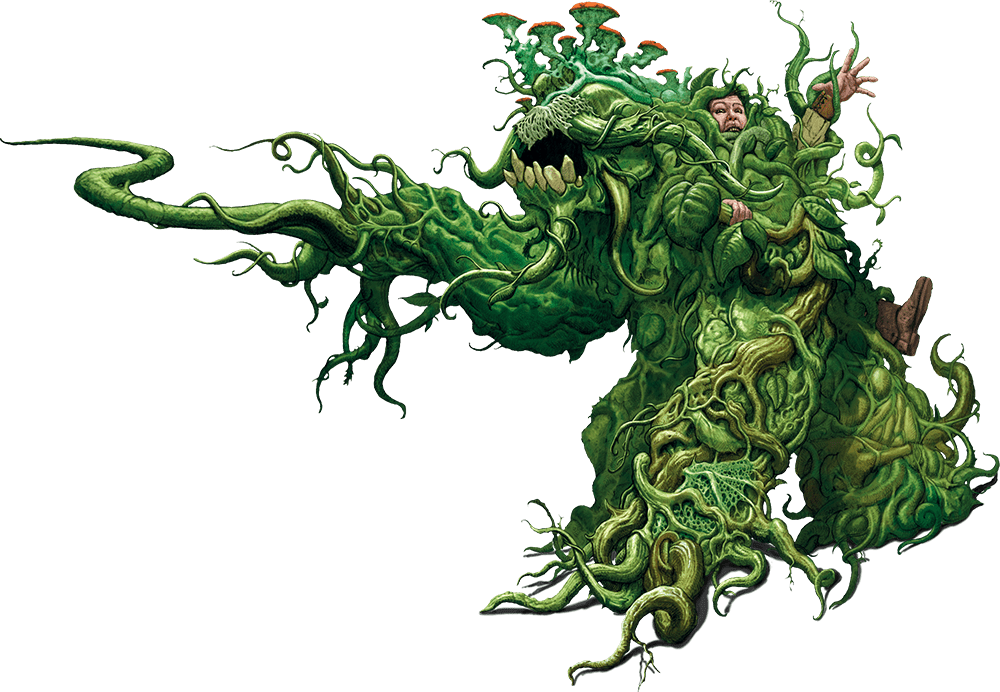
The Waxen Shambler (or Candle Golem) is an idea I came up with for a haunted chapel. It's essentially a Shambling Mound, comprising the waxy mass of hundreds of melted together liturgical candles rather than vegetation. 

Waxen Shambler

Armor Class: 10 - a slow moving blob isn't hard to hit

Damage Immunity / Resistances: Immune to normal missiles & bludgeoning attacks. Other weapons deal half damage.

Vulnerabilities: If it takes cold damage, it will move at half speed and only take one attack. If it is set on fire, it will take double the normal recurring damage but will act as if under the effects of a Haste spell until the fire burns out.

Hit Dice: 8d8 (36HP) + Regenerates 5hp / round

Attacks: 

  • 2x bludgeoning limbs, +2 to hit, d12 damage
  • Engulf - if both limbs hit, the target is swept into the mass of the shambler and will suffocate in 3 rounds unless freed.  
Move: Half human speed

Saves: 12+ 

Morale: Implaccable

Encounter Design

This thing is very hard to kill but pretty easy to flee. It won't chase beyond the church building.

My hope is that it pursues the party around the church area, maintaining pressure but they're smart enough not to stand against it toe-to-toe.

If they set it on fire... characters are likely to die. 

Loot

You'll undoubtedly find the oddments of previous victims lodged amid the mass.


Big inspiration for my design


Tuesday, March 25, 2025

Ghouls

Dekades8 on Devinatart

I feel a little silly including ghouls in my series of Undead revisions, since my model for this project, Arnold K's Monstrome, contains an extensive entry and my vision for this monster overlaps significantly with his. Nevertheless, ghouls are one of my all-time favorite classic D&D monsters and I want to crystalize my ideas in text (for my own use if for no other purpose).

Ghouls are an excellent utility monster that I find myself reaching for again and again while stocking my dungeons. With their multiple attacks and paralyzing touch, they are an absolute nightmare for players and remain a real challenge even for parties well above their level. 

Paralysis Death Spiral

I play in an OSE Arden Vul campaign and we recently encountered a mixed pack of ghouls and ghasts. Being a mid-level party and filled with hubris, we foolishly believed we could tank our way through. In one round, we were utterly thrashed, our best fighters paralyzed and several characters killed. We fled with half our number still living and a burning desire for vengeance. We came back, better prepared, and they kicked our asses again. This seems typical.

Ghoul's combat prowess borders on the unfair. A lot of people, both players and DMs don't like the brutality of Ghouls. Arnold removed their paralysis effect replacing it with a fear mechanic, saying "I don’t like how paralysis can disable half the party in a single turn, creating an instant death spiral (especially when surprise is involved), so I think this is a good change."  I disagree.

Ghoul's overwhelming abilities creates a fear and hatred of them that emotionally impacts the players in a way that few other monsters do. Having just experienced this, the frustration of rapidly losing characters that we'd spent months advancing, is fresh in my mind. When (on the third attempt) we finally beat them with an elaborate barbed-wire, tower-defense style ambush the sense of victory was incredible. 

A ridiculously overpowered, perhaps even un-fun, enemy from time to time adds something special to the game. It's exciting to have something to really fear.

Weaknesses

For all their lethality, ghouls are not that tough themselves. They typically don't have armor and with just two hit-dice, they fall pretty quickly once attacked. On average, they have single digit hit points. 

According to the 1e Monster Manual: "These creatures are subject to all attack forms except sleep and charm spells. They can be turned by clerics. The magic circle of protection from evil keeps these monsters completely at bay." 

In a different game I play in (in Stonehell) we encountered a ghoul infested area with a 7th level cleric and a paladin in the party. They melted like snow. 

Wednesday, January 22, 2025

Skeletons

Van Gogh

Of all the monsters in D&D, skeletons are the one most often depicted in art (of the non-game related sort). They are a constant theme. Drawn, painted and sculpted throughout history. A reminder of the inevitability of our own deaths and the monster that lives inside each of us, hidden behind a mask of meat and skin. 
William Blake

So of course I want to make them into a goofy cartoon monster. I want puppets and stop motion aesthetics. 

When you fight skeletons in my game, I want you to almost see the marionette strings. When you strike a mighty blow, they should burst apart with a clatter of scattering bones.

Disney

If you're going to take an easy, low-level undead fight for granted... these are the ones.

And yet... we still need them to be at least a little challenging to fight. They can't just be a very small stack of hit points.

Harryhausen

Strengths

Unlike the classic skeleton (BX/OSE and 5e), my skeletons are immune to slings and arrows (an outrageous fortune) and take half damage from piercing weapon. This makes them difficult to fight at range or if they are behind bars or a grate. This sets up lots of opportunities for adventurers to be harassed by weak monster that are difficult to get at. The challenge of the fight isn't rolling bigger numbers, it's figuring out how to get from here to there.

A complimentary feature is skeletons' ability to see in the dark and shoot further than torchlight extends. Arrows out of the darkness terrify players. This can be used to good effect to emphasize the importance of light.

Finally, skeletons have time on their side. They don't get hungry. They don't need a pee break or a nap. You can put them in a cage and hang them from the ceiling or brick them up behind an arrow slit. They can be a trap or an environmental hazard.

Weaknesses

In addition to being flimsy, skeletons are incredibly stupid. They are easily tricked. 

Sunday, January 19, 2025

Zombies

Maybe it's a fools errand, but I want to make the zombies in my game a little more interesting and threatening. I want my players to be genuinely scared of the undead.

I tried an iteration of this last year that fell bit flat so I've tweaked the recipe a bit.

Justin Moll

Sponge Monster

Zombies should shrug off weak hits and soak up a lot of damage before collapsing. On the flip side, in keeping with the tropes, one really big hit should take a zombie out. 

Instead of giving them a ton of HP, they'll get damage resistance (reduce the damage of each incoming hit by 4).  This will make them very resistant to arrows and small hand weapons. You'll want to hit these things with two-handed swords and polearms.

Deadly Infection

A zombie will first attempt to grab victims. Once grabbed, zombies will make bite attacks with advantage.

Any character bit by a zombie will contract grave rot, a deadly wasting disease that most low-level parties will not be able to cure. Getting bit by a zombie usually means death. 

Grave Rot: Every hour, lose 1/4 of your max HP. Hit points lost in this way can't be healed until the disease is cured. If you die while under the effect of Grave Rot, you'll return as a zombie (or occasionally some other undead). Grave Rot spreads from the point of infection. If it's on a limb, quick amputation can be a viable cure.

In B/X, 2HD crab spiders have save-or-die poison, so this doesn't feel too punitive.

Weaknesses

Zombies are slow and stupid. They always lose initiative and move at half normal human speed. If you can get out of their sight for one combat round, they'll forget you exist.

If a victim is brought down, zombies may stop fighting to consume it, ignoring anyone nearby unless directly attacked.

They are nearly always unarmored and make no attempt to avoid being hit. 

Monday, January 6, 2025

Tar Body Maggot


Darkest Dungeon

Maggots the size of a golden retriever. Slow moving, they are drawn by the smell of living flesh. They will attach themselves to any living creature and begin to feed. Any puncture of their thin skin releases a thick adhesive that can easily entrap attackers. 

Tar Body Maggot

Armor Class: 8 (unarmored). 

Hit Dice: 1d6 (HP4)

Attacks: First attack to attach (no damage), + 0 to hit, ignores armor. Once attached deals automatic damage each round until removed. First round deals 1 HP, second 2 HP etc. damage escalating as it chews its way further into the victim's more vital bits.

Move: 1/2 speed of unencumbered human. Can move on walls and ceilings.

Saves: 13+

Morale: Very stupid and will mindlessly pursue prey. Can be driven back temporarily by intense heat or cold.

Number Appearing: d10 x 3

Special: Hitting it with a bladed or piercing weapon releases super sticky goo. It will trap & tangle the weapon and potentially the attacker too (a la the folkloric Tar Baby). If killed, they melt into a big gluey puddle that will trap anyone stepping/contacting it. This smells intensely sweet and will attract other scavengers.

Saturday, September 7, 2024

A Few Magic Swords


Plutonium Sword
- One-handed, heavy, d8 damage. Forged of literal death metal. Drawing the sword from its heavy, protective scabbard, exposes the wielder to destructive radiance but an enemy struck by this dread blade will quickly sicken and die.

  • Takes up two inventory slots (or double a normal sword). 
  • When drawn, and for every Turn that the sword is out of it's scabbard, the person wielding the Plutonium sword permanently reduces their maximum hit points by 1.
  • Anyone struck by the sword takes an additional d12 damage at the end of each of their turns until they die as their body twists and mutates. They'll grow razor sharp spines of coral from their bones, or vomit out their organs, or their flesh will peel off in strips like a string-cheese. Only the strongest magic can reverse this.
  • This is a legendary artifact, and once a wielder is identified, they'll be hunted by those wishing to take it.
Rictus - Smallsword, finesse, d6 damage. If maximum damage is rolled, the target is paralyzed until the sword is removed. Might not work on non-humanoids or those with strong magical protection.
A fun encounter: Adventurers discover a vampire pinned to the wall by a smallsword (detects as magic). While impaled, the monster is inert, removing the sword frees it.


Ink Knife - Gladius, d6 damage. A tattoo of a sword on the inside of a person's forearm. When rubbed, it manifests as a physical sword in their hand. Rubbing the pommel returns it to tattoo form. 


Themis, Sword of Law 
- Executioner's sword, two-handed, d10 damage, Deals +3 damage vs. bandits, rebels and criminals. If used by a lawbreaker, it acts as a -3 cursed sword that will wound it's wielder on an attack role of 3 or lower. 


Illuminare -  Longsword, versatile,  d8/d10 damage. When drawn from the scabbard, it casts the Light spell on itself. To re-charge, it must be left in the sun for one full day.  


A few more from the legends:

Harpe: Bronze sickle sword, d6, +1 damage. Never dulls. Rumored to be older than human history.

Tyrfing: Ancient iron sword. d8, +1 damage. Shines like a torch when drawn. Cursed: If drawn from the scabbard, it can't be released from the hand until it has killed. 

Nail: Heirloom sword, broken at the end.+1 to hit, d8 damage. Roll damage with advantage vs. reptiles.

Durendal: Holy longsword. +2 to hit, +2 to damage. Can cut through stone. Relic of the paladin Roland.  

Dyrnwyn: White-hilted, arming sword, d8 damage, +1 to hit for it's owner. If loaned to anyone else, it also deals +2 damage. Anyone borrowing it, will feel compelled to return it once used and will refuse to ever borrow it again.


Monday, August 26, 2024

The Smokehouse Dungeon

As my Wild North Campaign continues, the party has ventured away from Gulworth Keep and the Caves of Chaos to visit Hommlet and consult Jaroo the Druid and seek further information on the local insurrection that has disturbed the Keep.

I've re-imagined Hommlet's classic "Moathouse" as a Rebel stronghold which I'm calling the "Smokehouse"

  • The Rebels in Cave C are brokering the purchase of iron weapons for the Hillmen in exchange for voidstone mined in Cave D. 
  • The voidstone is brought to the Smokehouse where it is cooked in a furnace, ground and processed into gunpowder. 
  • Lareth the Beautiful has been re-imagined as a crazed alchemist, overseeing the voidstone transformation. 
I have tried to maintain the most memorable Moathouse encounters, while simplifying the upper ruins. Most of the animal encounters (other than the frogs) have been elided, replaced with gun-toting Rebels and an Arnold K inspired ghost

I've re-structured the dungeons below, to be more vertical, with a central smoke-filled chamber ascending through all the levels. Again, trying to keep the most iconic bits, while replacing the vanilla with more exciting challenges. 

The Smokehouse (above ground)

Saturday, August 10, 2024

Robbing Rogues & Ruffians: d47 Search the Body Table

One of my favorite conventions of the OSR is the "I search the body" table. 

My players really enjoy treating low-level bad guys like pinatas -- beating little treats out of them.

I try to make custom search-the-body tables for every major class of enemy (I've done beastmen a couple times, bandits, oozes, philosopher apes, cultists, aliens,  monkssmugglers twice) and often one or two for every dungeon. 

Typically, these live on post-its, or index cards loose in my notebook.

David Sutherland from AD&D DMG

Sunday, August 4, 2024

Maze of the Minotaur

PDM's mini, from 0:05 in the video 

Continuing on my PDM inspired, update of B2 Keep on the Borderlands, I'm doing a nearly direct rip-off of the Professor's method for Cave I: Caves of the Minotaur. 

Rather than, meticulously time-tracking and mapping through a maze (a process that many, including me, find tedious), he abstracted the maze with random movement between points of interest. Despite the simple mechanics, I had to pause and re-watch several times so I wrote it up for myself (and anyone else who wants to run it).

Friday, August 2, 2024

Mummy Hands

Little scuttling horrors. Disembodied hands skittering and leaping -- grasping, driving fingers into flesh with ab-human strength. 

They look like Thing but fill a niche with the face-hugger, the headcrab and the rot grub. An ambush, nuisance monster. Individually weak but very deadly if they slip past your defenses. 

Addams Family (1964)

Tuesday, May 21, 2024

d133 Roadside Meetings

With my ongoing campaign heavily influenced by Professor Dungeon Master, I figured it was time to share one of my first PDM inspired creations, something I made years ago and have used frequently since.

One of his first campaign videos, described a session that was essentially a series of road encounters based on a big list that he'd prepared in advance. Rather than share his list, he urged viewers to create their own. I did. 

I wrote a bunch of encounters on post-its while killing time between other activities and pasted them into my notebook. It was fun typing them up and reminding myself how they really imply a setting (something very WFRP-ish). 

1. Hanging cage

2. Vagrant looking for work

3. Blackmailer head to town to confront her victim

4. Artisan with a cartload of wares

5. Political dissident - not too shy to criticize the establishment

6. Political commissar - ready to enforce proper belief

7. Man chained to a tree

8. Wagon full of stolen art, abandoned

9. Frankenstein's monster, escaped

10. Hunchback struggling to fend off two beautiful bullies

11. Zhentarim mercenaries - Fantasy Blackwater

12. Evil alchemist - Eager to source exotic ingredients and promising high pay

13. Friendly alchemist - Free samples!

14. Gunpowder Wagon - Driver and guards are dead

15. Assassin - If the players have a hit out against them, this is the guy. If not, he's super nice

16. A friend of the party, fleeing from an angry gang. Maybe they deserve it?

17. Acting troupe

18. Friendly woman with a pet monkey (a pickpocket)

19. Sudden ice storm

20. Blizzard - whiteout conditions

Monday, May 20, 2024

Owlbears Must Die!


My re-mixed, PDM inspired, version of B2: Keep on the Borderlands continues. It's acquired the name the "Wild North" campaign (like Wild West but turned 90 degrees)and this week my players surprised me by delving into a cave I was not expecting. 

This was our 4th delve into the caves. So far they've cleared out Kurtzman's Creepers, dipped their toes into the Mines of the Mutants (Caves D&E) and skirmished with the Hill Men in Cave F. Consequently, I was anticipating a stronger push into the left flank of the canyon to be the most likely plan or much less likely a probe into the Brugor or Rebel Caves to the right. 

I had not planned for them to plunge straight to the back of the canyon and assault Cave G, home of the infamous Owlbear. Nevertheless, I had an excellent little module to run for them. 

Players' diagram of the cave entrances

Monday, May 6, 2024

Burrow of the Brugor & the Rebel Redoubt

Drawing is mine, modelled on Lydos' pot

My B2 Campaign is underway! This post continues on from my Cave of the Creepers (revising the Kobold Caves), this time updating the Orc Caves (B & C).

  • Again, my updates take as much inspiration from Professor Dungeon Master's videos (Orcs & Bandits) as they do from the original module. 
  • Dyson has some upgraded maps that I referenced while making my version.
  • I've tried to keep the maps and room contents similar in spirit to their original versions, but I've added a few connections to make the dungeons loopier. 

In my versions, I've replaced the orcs in Cave B with Brugor (because I can't get enough of beastmen) and those in Cave C with a rebel faction, opposed to the imperial rule imposed by the governor, Lord Kostritz at the Gulworth Keep. 

Burrow of the Brugor


The brugor in Cave B, have gathered under the iron hoof of Borghast, a ram-headed adept of Baphomet from the frozen chaos wastes. He came to the Caves of Chaos about a year ago, drawn by the malignant energies of the fallen star that created this ravine and the psychic shadow of the chaos rituals being performed in this area. Since arriving he has been assembling an army of his descendants to invade the soft human lands.
  • Borghast supervises the cultivation of an alchemically potent fungus (grown on the living bodies of sedated humans) which he trades to the rebels in Cave C for liquor, salt & molasses imported from the human towns.
  • The brugor are gathering strength & stockpiling resources by raiding local farms and ambushing foresters. They will bypass the Keep and attack the town of Hommlet in one month. 

Map Key: 

  • Entry: I've kept the classic wall of severed-heads gimmick, with one head being a watchman spying from Area A.
  • Areas 7 & 8: Guardrooms. Will respond & attempt encirclement if alerted.
  • Area 9: A major hall, equipped with big, crude tables.
    • Many human bodies being cured into hams. Provisions for the impending invasion. 
    • Several donkeys present. Pregnant with brugor children. When"Speak With Animals" is inevitably used by the party's druid, they'll proclaim how great it is being with the brugor.
  • Area 10: Barracks: A dozen brugor. Likely very drunk. Slow to respond to alerts in other rooms.
    • Raised planters filled with bones: growing Corpse Shrooms. These mushrooms restore 1hp & impart memories of the dead if consumed.
  • Area 11: Fungal Vault: Fluorescent orange fungus grows on sedated humans.
    • This fungus is the active ingredient in the infamous "God Talk" drug and is useful for producing "Enlarge" & "Haste" potions. It is a vital trade good for the Brugor. d12 Jars of finished product (worth 200GP each) are stored in the closet at Area B.
  • Area 12: Borghast's Chambers: 
    • Borghast is clad in chainmail and has a war-axe from his past adventures. 
    • A locked iron chest contains his treasures: 200GP in mixed coins, a potion of healing and a scroll of fireball that Borghast can't read, but knows is valuable. 
    • The niche in the NW corner of his lair is a shrine to Baphomet, goat-headed demon of vengeance. 
    • Behind a dingy tapestry, there's a crudely hidden door into Area 13
  • Area 13: This secret room is where Borghast meets with Janus, leader of the rebel faction in Cave C to exchange his fluorescent fungus for rotgut. 
    • Contains several cases of Rothko's Rotgut and 2 jars of fungus worth 200gp each to a wizard or alchemist
    • Janus believes that by supplying the brugor with alcohol she's blunting their danger to the region.

The Rebel Redoubt


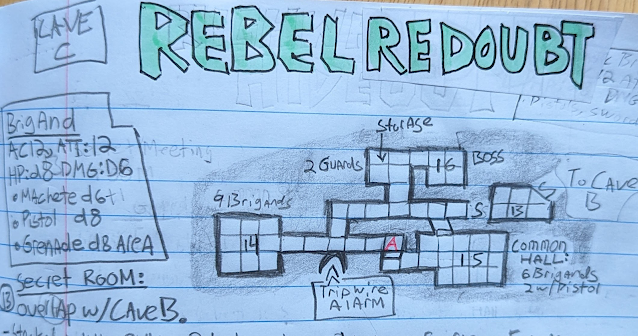
There is an organized resistance to the imperial authority enforced from Gulworth Keep. An important cell, under the command of Janus, has taken up residence in the Caves of Chaos. While not entirely aligned with the goals of the Chaos Cultists controlling the valley, they use the other denizens as cover from the authorities and trade partners to acquire important resources. 
  • Janus has an agreement with Borghast (in Cave B) to buy alchemically potent fungus, which she sells on to the rogue wizard Hieronymus Tulgar for a staggering profit. This is becoming an important funding source for the movement.
  • Janus is also working with the Hillmen  warriors in Cave F. She has brokered a deal to provide them with steel weapons in exchange for a large shipment of Warpstone mined from Cave D. I'll get to caves D, E & F in a future post. 
    • Warpstone is the primary component in the gunpowder the rebels are manufacturing elsewhere (at the Smoke House, another dungeon I'm working on). 
  • Frontal assaults on the Redoubt are likely to be very bloody. Janus' fighters are well armed with swords, pistols and grenades. 
  • The fighters wear Zorro-style masks.

Map Key: 

  • The Entrance is rigged with a trip wire that will trigger an alarm bell. 
  • Area 13: A large wardrobe hides the entrance from this side, the hidden room can be accessed via a moving panel in the back. 
  • Areas 14 & 15: The living quarters of the rebels. Fighters from these locations will respond to any alarm. 
    • Area A on the map denotes a black powder claymore set up to fire down the hallway. It is triggered by a pull string from Area 15. 
    • If assaulted, fighters in Area 15 will bar the door. While 2 defend, the rest will circle around via the northern passage to flank the attackers.
  • Area 16: The quarters of Janus
    • Janus is a tall red-headed woman. She'll be armed with a pair of pistols and an epee. She wears a large gold belt buckle worth 100GP. 
    • The antechamber to her room, contains a large locked wardrobe containing 1000GP worth of warpstone ore, 3 jars of orange fungus and a potion of Enlarge Self. Next to the wardrobe, two large crates contain 40 machetes.
    • In her chamber, Janus has a writing desk containing written correspondence:
      • Letter from Hieronymus Tulgar regarding his purchase of fungus
      • Letter from a senior Rebel officer approving the exchange of machetes for warpstone. 
      • Letter from a Druid in Hommlet, expressing interest in further discussion of "matters of mutual concern"
      • Several inflammatory pamphlets & a political manifesto.
    • Additionally she has: Ivory bracelet (100GP), a 100GP gem in the pommel of her sword, 50 ancient platinum coins, fancy copper bowl (50gp).
    • If combat seems to be going poorly, she will retreat via the secret door to area 13 to fight another day. 

Friday, April 12, 2024

How My Light is Spent

Drawing is mine, modeled on a panel in Dracula Motherf**ker
 
Lots of systems have existing light rules. Why make my own

I want my game to be streamlined so I don't always enforce rigorous torch timelines or sightlines. However for the right kind of classic dungeon there's a lot of interesting prioritization and strategy choices created by adhering to specific light rules. 

In this post, I've collected some of the things that make light & dark rules fun: monsters, spells, items and obstacles that create novel challenges and provide tools for creative problem solving.

Sean Cruz

This will be a fairly long post...